A Walk Through a Building’s Local Materials
A walk through a building’s local materials helps you read a streetscape carefully, notice regional character, and avoid mistaking appearance for proof of origin.
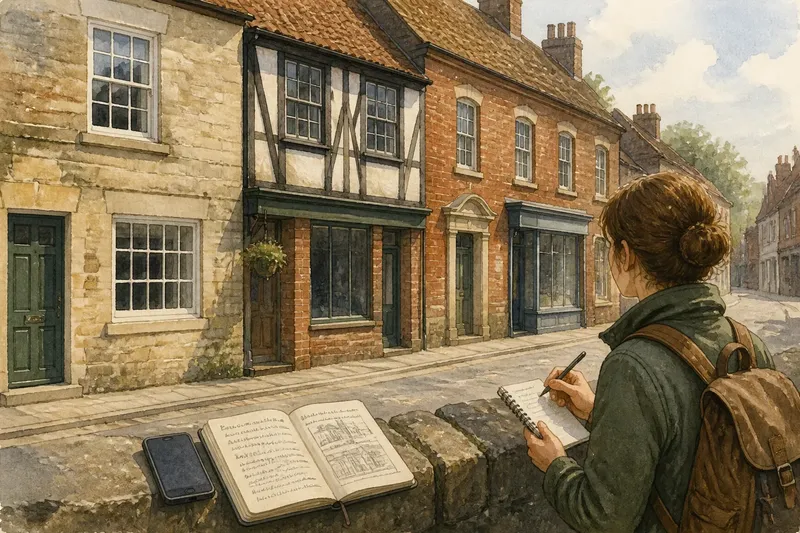
A walk through a building’s local materials starts with a simple distinction: what you can see is evidence of a building’s character, not proof of where its materials came from. Follow a street slowly and note stone, brick, timber, roof coverings, and repairs as parts of a visible pattern. The aim is to understand how materials shape the place, while leaving questions of origin open until you have stronger evidence.
This approach works for a single building, a row of shops, or a route through several neighborhoods. It also helps sort different situations: a material may be prominent, familiar, newly added, or hard to identify. Each calls for a different kind of observation. Keep the route simple, record what you actually see, and treat conclusions about regional sourcing as possibilities rather than facts.
What should you look for first?
Begin with the street as a whole before focusing on one wall. Notice which materials repeat across nearby buildings, where they appear, and what roles they serve. A local character can emerge from a combination: pale stone at ground level, dark timber above, and clay roof tiles along a row. None of those details alone establishes a material’s origin.
Choose a route with a few contrasting buildings. A main street, an older lane, or a group of buildings around a town square can make comparison easy. Walk at a pace that lets you look at façades, corners, entrances, and rooflines without blocking other people. If a building is behind a fence or partly hidden, record that limitation instead of guessing.
For each building, separate observations into three layers:
- Material: What seems visible, such as brick, stone, timber, metal, render, or glass?
- Use: Is it part of a wall, frame, lintel, step, roof, or decorative detail?
- Condition and change: Does it look weathered, patched, painted, replaced, or newly fitted?
A phone camera and a small notebook are enough for most walks. Photograph details from public places, and add a brief note about the location and your level of certainty. A map app can help you keep track of the route, but avoid treating a pin or street label as evidence about a building’s materials.
Which situation are you in?
The right way to read a material depends on what stands out and what you hope to learn. Use the closest situation below, then keep your notes focused on its limits as well as its clues.
What if one material dominates the street?
Record where it appears and what it does. A repeated brick wall or stone base may give the street a strong visual rhythm, even if the buildings differ in age or design. Compare the material’s color, surface, jointing, and placement rather than assuming that similar-looking examples share a source.
What if a material appears in just one building?
Describe it as a distinctive feature rather than a regional signature. A single timber porch or unusual stone doorway may reflect a renovation, a specific design choice, or a material brought from elsewhere. Check nearby buildings for related details before deciding whether it belongs to a wider local pattern.
What if the material is covered or difficult to identify?
Write down what obscures it: paint, render, vegetation, shadow, or distance. Use a cautious description such as “rough, pale surface beneath the window” if you cannot tell whether it is stone, masonry, or a finish. A clear record of uncertainty is more useful than a confident but unsupported label.
What if repairs interrupt the original surface?
Look for changes in color, texture, joint width, or the way a patch meets the surrounding wall. Record the repair as a visible layer, not as proof of a particular age or supplier. Repairs can explain why a building looks different from its neighbors without erasing the pattern of materials that remains.
How can you compare stone, brick, and timber?
Compare materials by observable features and building role. Stone may show variation in grain, color, edge shape, and how pieces fit together. Brick often creates a regular pattern, though size, surface, bond, and mortar can vary. Timber may appear as framing, cladding, a door, or a carved detail; paint and weathering can conceal its surface.
These cues help you describe what is present, but they do not reliably identify a quarry, clay source, forest, or workshop. Similar materials can travel, and nearby buildings can use different supplies. Even a strong resemblance to a nearby landscape is not proof that the material came from it.
Look at how the materials meet. A stone threshold under a brick wall, timber set into masonry, or a metal rainwater pipe against render can reveal how the façade is assembled and maintained. The junction often tells you more about a building’s visible construction than a broad label such as “stone building.”
Notice finishes, too. Mortar, paint, pointing, render, and protective coatings affect color and texture. A wall that appears to be one continuous material may combine several layers. Avoid scraping, touching fragile surfaces, or entering private property to investigate; observation from an appropriate public place is sufficient for this kind of walk.
What should you do when a building has changed?
Treat change as part of the streetscape, not as an interruption to be ignored. A replacement door, newer window, patched corner, or added storefront can sit beside older-looking masonry. Note the contrast and its location. Do not infer a building’s complete history from a façade alone.
Imagine you are walking past a row of brick shops and one has a pale stone doorway, a painted upper floor, and a newer glass entrance. You could note that brick forms the repeated street-level pattern, while the doorway and entrance distinguish this building. That description records the visible contrast without claiming the stone is local or assigning dates to the changes.
If a material’s identity matters to your question, seek a source suited to that question. A building owner may know about recent repairs; a local archive, heritage organization, or building record may describe documented changes. For questions about protected fabric or permitted alterations, consult the relevant local authority or a qualified conservation professional. Visual inspection alone cannot settle those matters.
How do you make useful notes on the walk?
Use a compact record that captures both pattern and uncertainty. For each stop, write the location, visible material, its role, a distinguishing feature, and any obvious alteration. Keep the description plain: “red brick wall with pale mortar, patched beside the entrance” is more useful than “historic local brickwork” when you have not verified its source or history.
- Map the repeat: Mark where a material occurs more than once and where it stops appearing.
- Describe the surface: Note color, texture, shape, jointing, and finish without naming a source.
- Record the building role: Distinguish walling from trim, paving, roof material, or a small decorative feature.
- Flag visible change: Note paint, patches, replacements, extensions, and covered areas.
- Separate observation from interpretation: Use phrases such as “appears to be” when identification is uncertain.
- Compare nearby examples: Check whether a detail repeats across the street or belongs to one building.
When you review the notes later, sort them into three groups: repeated features, isolated details, and uncertain observations. This makes it easier to describe the street’s material character without turning a visual pattern into a claim about supply, age, or ownership.
When can you call a material regional?
Use “regional” carefully. In an observation-led walk, it can describe a pattern that helps a place look distinctive: a material repeated across façades, a familiar combination of surfaces, or a building detail that recurs nearby. It should not imply a confirmed source unless documentation supports that claim.
That distinction matters because appearance travels. A brick type may be common across several regions, while a stone that looks familiar may have been brought from far away. Builders also reuse materials, and renovations can mix old and new supplies. A pattern can still be worth describing even when its origin is unknown.
If you want to investigate sourcing, move beyond visual clues. Look for building records, conservation notes, local histories, or information from a responsible owner or custodian. Check whether a source addresses the specific building and material rather than a nearby structure or a general tradition. If the evidence remains incomplete, say so plainly.
A walk through a building’s local materials is most useful when it leaves room for what you do not know. Describe the surfaces, compare their roles, and record where patterns change. The result is a grounded account of regional character—one that shows how buildings look together without pretending that a façade can tell the whole story of where its materials began.