The Old Clue Hidden in a Place Name
Learn how to read a place name’s linguistic clues, compare spellings and local geography, and separate a plausible origin from an attractive guess.
A place name can preserve an old word after its meaning has faded from everyday speech. To read a place name’s linguistic clues responsibly, start with the name’s forms and sounds, then test possible meanings against local records and geography. A suggestive ending is a lead, not a verdict.
What can a place name actually tell you?
A name may point to a landscape feature, a person, an activity, a route, or a word once used by a language no longer spoken locally. It can also change as residents pronounce it, clerks write it down, and mapmakers standardize it. Those processes leave clues, but they do not always preserve a name’s original meaning intact.
Separate three questions that are easy to blur together: What does the name resemble today? How was it recorded in earlier forms? What explanation best accounts for the evidence? The first is an observation; the second is a record; the third is an interpretation.
For instance, a name ending in a familiar word for “ford” might indeed refer to a river crossing. But the ending could instead come from a different language, an older spelling, or a word that merely sounds similar. Treat the resemblance as a possibility to investigate, not a translation.
How should you begin with the modern name?
Write the current official spelling exactly as it appears on a reliable local map or municipal source. Note how local speakers pronounce it, including stress and any sounds that a spelling may conceal. If pronunciation varies between nearby communities, record that variation rather than choosing one version as unquestionably original.
Then split the name into possible parts, but keep the split provisional. A place name that looks like two familiar English words may have arrived as a single borrowed word. Conversely, a compound may have joined elements from different periods or languages.
- Record the full spelling and any locally used alternative.
- Mark syllables and stress as people pronounce them.
- List possible word boundaries without assigning meanings yet.
- Note nearby names that share a sound or apparent ending.
- Keep uncertain letters and pronunciations visibly uncertain in your notes.
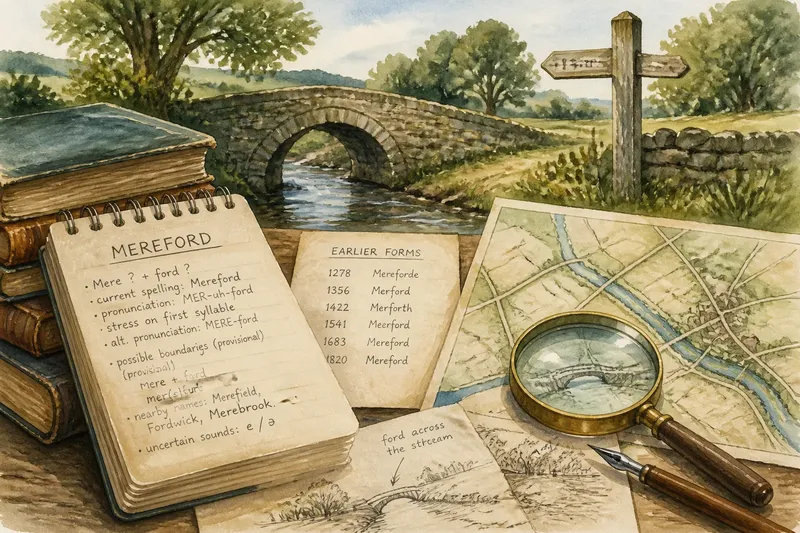
Say you are looking at the invented name “Mereford,” beside a stream. You might tentatively divide it into “mere” and “ford,” then check whether older records support those parts and whether the crossing existed where the name is used. The stream makes one interpretation worth checking; it does not establish that interpretation by itself.
Why do older spellings matter?
Earlier spellings can reveal that a modern form has changed in ways that obscure its parts. A vowel may have shifted, a consonant may have disappeared in speech, or a writer may have represented a sound using a different spelling convention. A sequence that looks meaningful now may have formed by accident after several changes.
Look for dated forms in sources such as local histories, place-name dictionaries, historic maps, parish or town records, and public archives. Prefer sources that show where a form came from and when it was written. A list that gives only a proposed meaning offers less to assess than one that documents earlier spellings and explains its reasoning.
Compare the forms in chronological order. Ask which sounds remain stable, which change, and whether a proposed division could plausibly produce the modern name. Do not assume the oldest spelling is automatically the original: it is simply the earliest form you have located, and it may reflect a clerk’s spelling rather than ordinary local speech.
How can you test a possible meaning?
Check whether each proposed element fits the language and period associated with the place. A dictionary entry for a similar-looking word is not enough. The word must have been available in the relevant language, and the sound changes between its proposed form and the recorded spellings must make sense.
Next, consider the type of feature named. A term for a hill, wet ground, settlement, or crossing should fit the location or the way people used it. The terrain may have changed, so a present-day view is not a complete record. Old maps, drainage patterns, land descriptions, and neighboring names can add context without settling the question alone.
Check whether the proposed element appears elsewhere in the region with a comparable meaning and a documented history. Similar names can help identify a local naming pattern, but resemblance across distant places may be less useful if the languages or histories differ.
Finally, compare competing explanations. If one account depends on several unsupported sound changes while another fits recorded forms and regional naming patterns, the second may be more plausible. Still, “more plausible” is not the same as certain.
Which questions help separate evidence from guesswork?
Does a familiar word prove the name’s meaning?
No. A modern word may resemble an older element by coincidence, or the name may have passed through another language. Look for earlier spellings and a sound history that connect the proposed word to the form in use.
Can local geography confirm a proposed origin?
Geography can support or weaken an interpretation, especially when the name seems to describe a feature. It cannot prove the origin on its own, because landscapes change and names can refer to features that are no longer obvious.
What if two explanations both fit?
Keep both possibilities open and identify what evidence would distinguish them, such as a better-documented early form or a regional parallel. If the evidence does not decide between them, say so rather than choosing the more colorful story.
Where should you look for a reliable interpretation?
Try a specialist place-name dictionary, a local archive, a university or public library collection, or a regional history that identifies its sources. An explanation that shows its evidence is easier to evaluate than an unsourced claim repeated across websites.
How should you describe an uncertain origin?
Use wording that matches the strength of the evidence. “The name may contain an element meaning…” signals a possibility. “An early spelling supports…” describes a record. “The origin is uncertain” is appropriate when the available evidence does not distinguish between explanations.
Keep the proposed analysis separate from the documented facts. For example, you can state that a map records a particular spelling, then explain that a specialist source interprets one part as a landscape term. Readers can see where the record ends and the interpretation begins.
Avoid turning an appealing local story into linguistic evidence. Stories about a named founder, dramatic event, or distinctive landscape may be meaningful to residents, but they need independent support before they can explain how a name formed. Preserve the story as local tradition if that is what the evidence supports.
What should you keep when you share your interpretation?
Save the exact spellings, the source for each one, and the reasoning behind your preferred reading. A short note can include the modern form, pronunciation, earliest form you found, possible elements, relevant landscape context, and unresolved questions. Record sources clearly enough that another reader can check them.
For the invented “Mereford,” a careful account might say that the modern name resembles two English terms and lies near a stream, while the proposed “ford” element remains unconfirmed until older forms support it. That phrasing gives the reader a useful lead without presenting a guess as a settled translation.
The old clue hidden in a place name is most useful when it points toward evidence rather than ending the inquiry. Keep the spellings and pronunciation attached to your explanation: future readers may find a record that changes how the name’s parts fit together.